
Vanderburgh County Civil Docket Searches
Indiana MyCase covers the public civil dockets filed in Vanderburgh's Odyssey courts. A full case number is the fastest way in. You can also search a person or business name. Then narrow the results by Vanderburgh court, filing date, civil category, and status. Expect prefixes like 82C01 for Circuit and 82D01 through 82D07 for a Superior division.
When a public case summary shows no image for a filing, call the Clerk. The number is 812-435-5160. The counter in Room S240 handles walk-in questions too. A mailed public-record request can seek inspection, pickup, or copies. Small Claims runs its own desk. Call it at 812-435-5166, Room S241. Older paper records and certified copies come from the Clerk, not from repeated web searching.
- Choose Case or Name in MyCase.
- Enter the cause number, party, or exact business name.
- Limit the search to Vanderburgh and the likely civil type.
- Match the court, filing date, caption, and status.
- Read the CCS, then request any missing or certified document from the Clerk.
Vanderburgh Civil Case Codes
Every Indiana case number packs in the court. It also packs the filing year and month, the case type, and the filing sequence. A civil matter might carry something like 82D01-2608-PL-000123. That string is only a format sample. The PL marks civil plenary work. The first group routes the case to a court. Always trust the live cause number on the filing or search result.
| Code | Vanderburgh civil docket type | Useful search point |
|---|---|---|
| PL | Civil plenary, often contract or equitable matters | Name, case number, assigned court |
| CT | Civil tort | Party and filing range |
| CC | Civil collection | Current Rule 8 classification |
| EV | Eviction filings after the 2020 classification change | Case number and Division VI where assigned |
| SC | Small Claims | Division VI and Small Claims desk |
| DC, DN, MF | Family-related case classes | Public access varies |
| PO, MH, XP | Protective order, mental health, expungement | Special access rules may apply |
The code tells you what kind of filing opened the case. It says nothing about who prevailed or whether judgment has been entered.
Civil Dockets: What They Show
The civil Chronological Case Summary lays out the case history in date order. You may see the caption, party roles, and court. Filing date, status, hearings, motions, orders, judgment, costs, and links to public files can appear too. Which documents are viewable depends on type and age. And if no image appears, that is not proof the paper was never filed.
| Case and court | The cause number, assigned Odyssey court, and case type. |
|---|---|
| Parties | Public caption and the role of each listed person or entity. |
| Filings | Complaints, answers, motions, notices, and other dated entries. |
| Hearings | Date, type, judge, and location when supplied. |
| Orders | Rulings entered by the court, sometimes with a public image. |
| Judgment and costs | Recorded outcome and financial entries, subject to clerk confirmation. |
Keep in mind the CCS is not the whole case file. An exhibit can be missing even when the docket lists the related order. Ask for the exact item by date and title.
Blind-Lot Vanderburgh Civil Assignments
Local rules send Superior Court civil cases out by blind lot. The pool is four rotating civil judges. Whoever draws the case usually keeps it. Transfers work differently. Cases from Small Claims, juvenile, or probate can be reassigned under the local civil plan. That lottery has a limit. A party name alone cannot reveal which division holds the live Vanderburgh County civil docket.
Check the cause number and court field in MyCase instead. Division I, 82D01, and Division V, 82D05, both take civil work. Circuit Court carries civil and county functions as well. A broad label like "county civil" decides nothing; the local rule does. A transferred case may therefore sit in a different court than where it began.
What Cases Fill the Civil Docket
The Vanderburgh civil docket spans many case types. These include plenary, tort, collection, eviction, small-claims, domestic-relations, mortgage-foreclosure, protective-order, mental-health, and expungement filings. Probate and juvenile cases go to Division VII. Under the county map, family work goes to Division IV. All of them open with a Rule 8 cause number. Yet each category can carry different access limits.
A civil label does not mean every attached file is public. Family, juvenile, protection-order, and mental-health matters demand extra care under Indiana Rule 5. Search results surface only what those access rules permit. For a nonpublic item, only the court can rule on a Rule 9 request.
Small Claims in Vanderburgh Civil Dockets
Small Claims stands apart as its own local access point. Superior Court Division VI takes the SC cases. Filing, service, cashier tasks, e-filing, and local rules are covered on the official Small Claims page. Clerk service sits in Room S241. Some forms and documentation live in Room 220. Reach the desk at 812-435-5166. You can also use the general Clerk line. That official page is also the source for the assigned image.
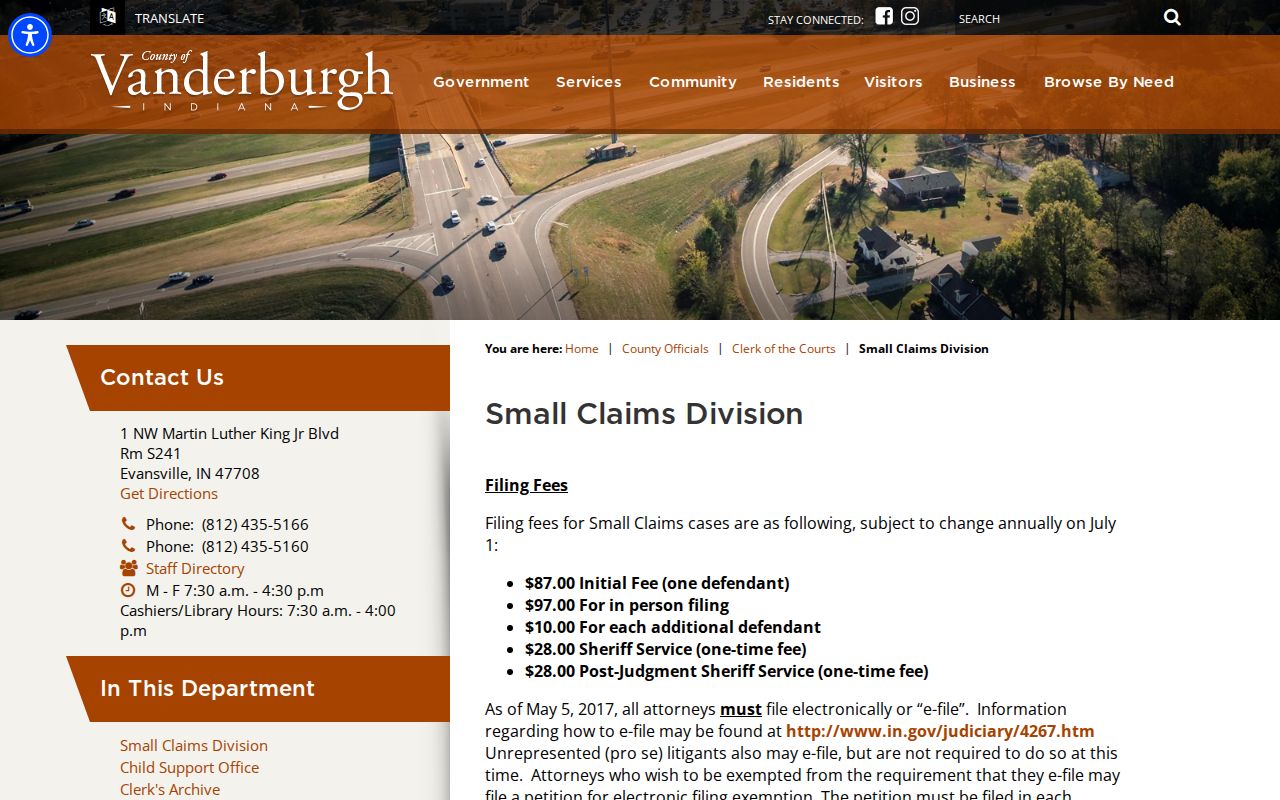
It points you to the county-specific small-claims channel. That is more precise than treating every civil record as one undivided docket.
Hearings on the Civil Docket
A setting is a scheduled event, nothing more. The Vanderburgh County civil docket might list a conference. It might also show a motion hearing, bench trial, jury trial, or another session. Confirm the date and description in the current CCS. Indiana Trial Court Calendars currently exposes only participating Vanderburgh nodes. So a missing calendar result never cancels a setting in another division.
- Setting
- The scheduled date and purpose of a court event.
- Continuance
- An order moving the event to a later date.
- Default judgment
- A judgment entered when the rules permit after a required response or appearance is missed.
- Disposition
- The recorded way the civil matter concluded.
Try MyCase first for the case-centered history. If a date is close, has changed, or clashes with a notice, call the assigned court or the Clerk.
Vanderburgh Civil Filing Context
Indiana's Office of Court Services publishes annual trial-court caseload and judicial service reports. Those reports define the filing categories. They give useful county context, but they cannot replace a live docket. A statewide statistical total proves nothing about one case. It does show why exact case types and court assignments matter. Keep that in mind when you compare civil work. The 2024 trial-court reports page is the source for this civil-court image.
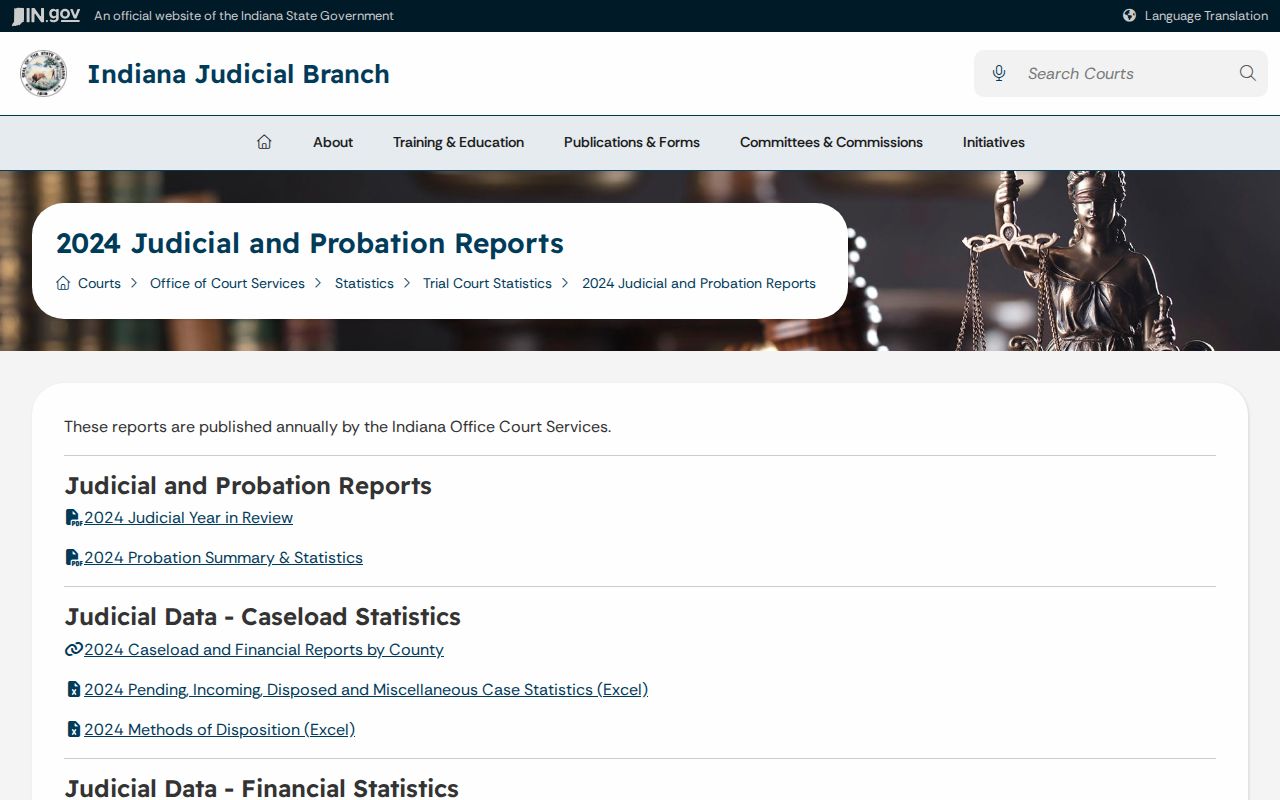
Rule 8 definitions give the vocabulary, and the official reports supply the background. For an actual Vanderburgh County civil docket, though, go straight to MyCase or the Clerk.
Historic Vanderburgh Civil Record Context
Vanderburgh County dates to 1818. Evansville is its seat. The courthouse story runs deep. Indiana's Bicentennial profile links much of it to the old canal basin. That long paper history explains a practical split in today's court records. Online access is strongest for Odyssey-era civil files. Older material may still need a paper or archival request through the Clerk. Indiana's Vanderburgh County profile is the source for this local image.
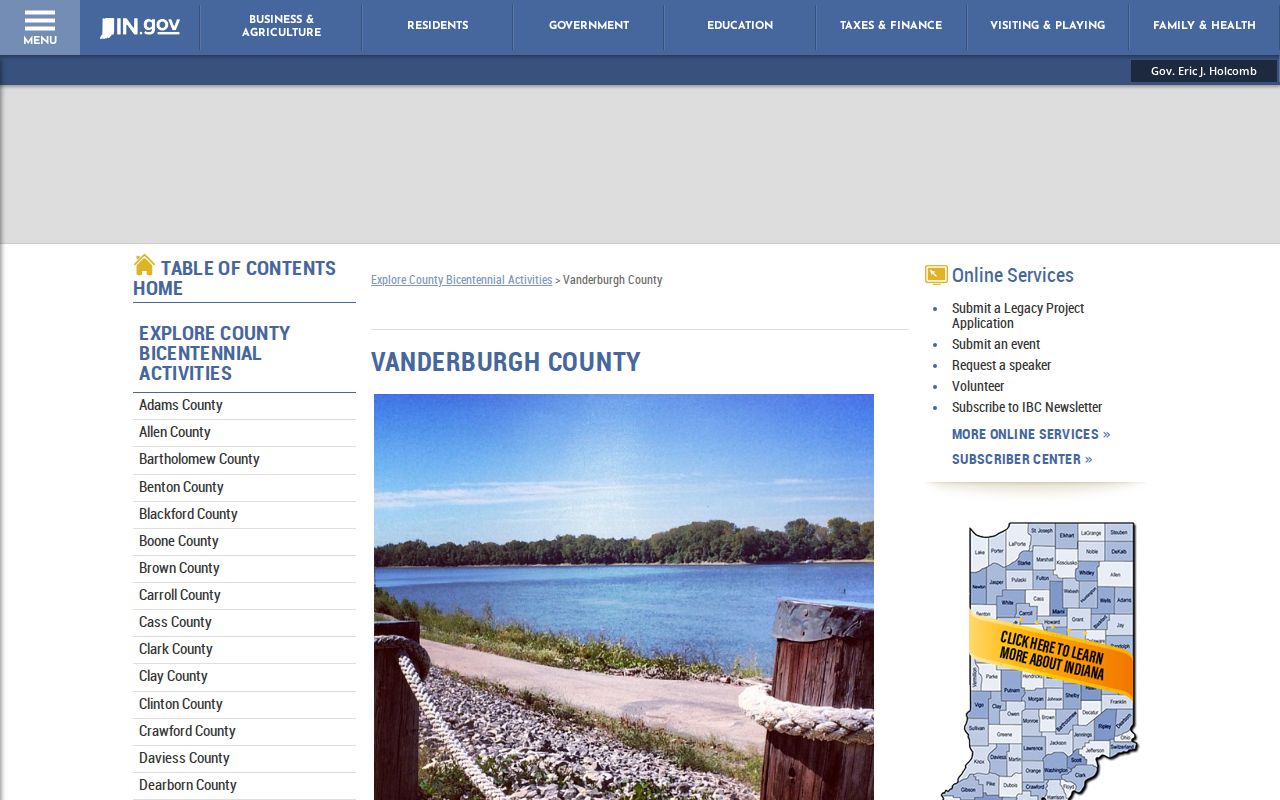
History alone will not pull up a case. When a name search cannot reach an old Vanderburgh civil file, the Clerk is the office to call.
Who Can See Civil Dockets
Indiana presumes that court records are open to the public. Rule 4 of the Indiana Rules on Access to Court Records states that presumption. Rule 5 carves out confidential material. Rule 9 explains how to ask for access to an excluded record. The Access to Public Records Act sits alongside those judiciary rules too. Indiana Code 5-14-3 applies to court files.
Access point: A public CCS may be viewed online, but confidential data and sealed documents remain governed by Indiana Rule 5. The court, not the search portal, decides a Rule 9 access request.
The Clerk's copy request form covers three options: viewing, pickup, or mailed copies. Costs run $1 per copy page. Certification adds $3. The form quotes the price before production, and payment comes first. Mail requests need a cashier's check or money order plus a return envelope. Expect a status notice within seven days, not the copies themselves.